
2026 - The Year of Art - Part 1
January and February
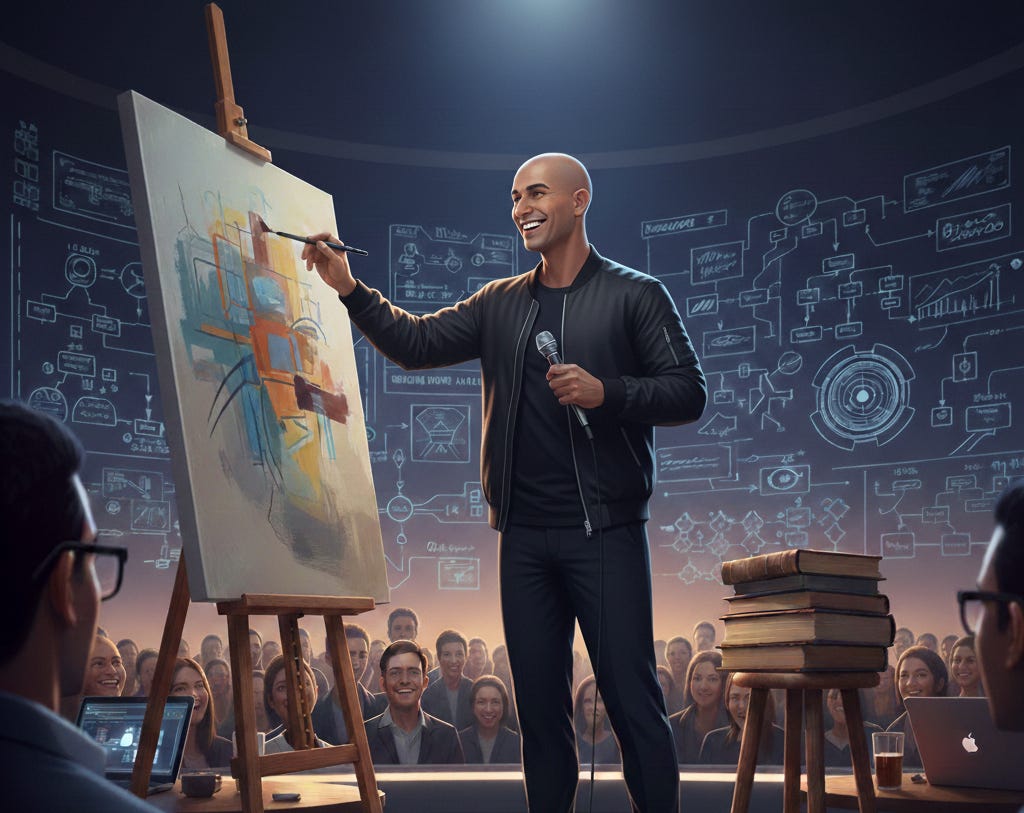
One of my iron clad laws for happiness and growth is that change is essential. Without change or dynamic movement, life and its experiences become stagnant. I also love the fresh psychological canvas of new beginnings to build upon. So I am a huge advocate for setting New Year’s resolutions. I also like deciding on themes for the year to help inform my goals.
Last year, the theme was travel. I was able to visit five continents and spent almost a quarter of the year abroad. This year, I decided that it was more important to stay local and build community. Because we are so immersed in technology, it was important to me to find activities that connect me with people and with an analog reality. So my theme for 2026 is art: to learn and practice as many varieties as I can.
This newsletter, Polymath Health focuses on the intersection of health and technology. While technology can augment health, especially in hospitals, clinics, and laboratories, there is ample evidence that our day-to-day well-being is negatively affected by technology. Our mental health, physical fitness, critical thinking, and ability to learn have been weakened by our excessive reliance and focus on technology.
As an aspiring polymath, it is also important for me to demonstrate how the lack or absence of technology can fuel growth, health, and happiness. In choosing what types of art I want to learn and practice, the more analog the better.
Many of the activities I undertake will depend on my work schedule and what I am interested in the moment. The goal is to learn and improve without putting too much pressure on myself. These activities should help me develop community, build artistic confidence, find deep focus, improve my well-being, and push me outside of my comfort zone.
Every two months, I will write about the major art experiences that dominated my time and what I learned from them. Hopefully, this will inspire you to put down your phone and get back in touch with your humanistic and artistic side. Otherwise the robots will win.
At the beginning of 2026, I signed up for various art classes at a couple of local community organizations. So far, I have completed introductory classes in improv comedy, stand up comedy, drawing, and painting. I also started writing this newsletter. Here’s what I learned so far:
Writing
Every year, I tell myself I want to write more. Every year, I fall short. This year I feel added pressure to follow through because literacy is in decline. On one side, social media has given rise the a new age of orality, where the spoken word now dominates. It has also led to the decline of book reading and general reading comprehension. On the other side, AI and large language models have made generic writing easily accessible and common place. We are flooded with AI slop.
But writing has always been a tool to learn, to organize one’s thoughts, and to express one’s feelings. It allows people to elucidate thoughts that are far too complicated to be spoken. It allows us to access thoughts by renowned thinkers centuries later. The transfer of information over social media is too ethereal, too abrupt, too abridged. The written words of AI are empty and without spirit.
There are a few other reasons why I want to improve my writing. First, I have had ideas and outlines for books on my computer, but I have not made headway towards writing them. Second, vibe coding is futile if you cannot write or express yourself and your needs clearly to the LLM. Finally, I am also interested in satire, but this requires practice and consistency. In order to push myself into the direction of humor writing, I decided to cross train with improv and stand up comedy.
Improv Comedy
If you want to improve your ability to live in the moment, to listen, to play, to collaborate, and to fail, then improv comedy is for you. The first few times I acted out scenes in class, I bombed on stage after I kept drawing blanks. Eventually, I grew comfortable with the other actors in the class and learned to open myself to act spontaneously.
Improv comedy is essentially playing make believe with other adults. Sometimes there is structure, like a suggestion from the audience about a location or character, or you are playing an organized game. Because of the spontaneity, the comedy tends to emerge organically, although the best improvisers (like on Whose Line Is It Anyway?) are skilled at creating characters and intentionally introducing humor into their performance.
The main lessons I learned was how to relax on stage, how to listen to my scene partner, and how to get used to failure. Sooner of later, nearly everyone runs out of ideas on stage and it is up to your fellow actors to rescue you with their own ideas. It requires building on each other’s ideas (using “Yes, and…”) and team work.
After a few classes, the bond you develop with everyone is so strong that, even if a scene I am watching is not particularly funny, I am still grinning because of how proud I am of the actors making bold decisions on stage. The last class of the session featured an improv performance in front of friends and family. Now I am continuing to level 2.
Stand Up Comedy
Stand up comedy is everywhere today. It is perfect for the second era of orality and social media. I have wanted to perform ever since high school, but never felt quite bold enough. Writing and performing spoken word poetry (something I will get back to) a couple of years ago seemed like a happy medium. There are important similarities and differences.
Both spoken word and stand up have different rules, but both rely on principles of timing, rhythm, word play, and language mastery. Spoken word is more forgiving, however. Poetry audiences may react positively, but even if they don’t, you will probably get polite applause after your performance. Silence during your performance is not necessarily bad.
Stand up is harder because the comic depends on audience feedback during the performance. It is less a one-way performance and more of a conversation. If the audience is not laughing, then you are not being funny. It can be a lonely experience to bomb on stage or have the audience turn on you.
Over six weeks, I wrote a five minute set, memorized it, practiced incessantly, and then performed on stage. For the first two weeks of February (last two weeks of the class), I wrote and re-wrote my set, saved every draft, and tracked how it transformed. I killed entire premises that I wrote at the beginning of the class before I was moderately content with the story and jokes I wanted to tell on stage.
Everything finally came together in the last week of the show. When I finally had a decent amount of my set memorized and when I had an idea on my cadence and timing, my brain relaxed. Suddenly more jokes came to mind and I was able to incorporate them.
Ultimately, I was happy with how the show turned out. I was nervous and practiced my set obsessively. Fortunately, the crowd was kind and jovial, so they laughed easily. There was a tremendous buzz of satisfaction from the budding comics. I feel encouraged to give it another shot.
Drawing
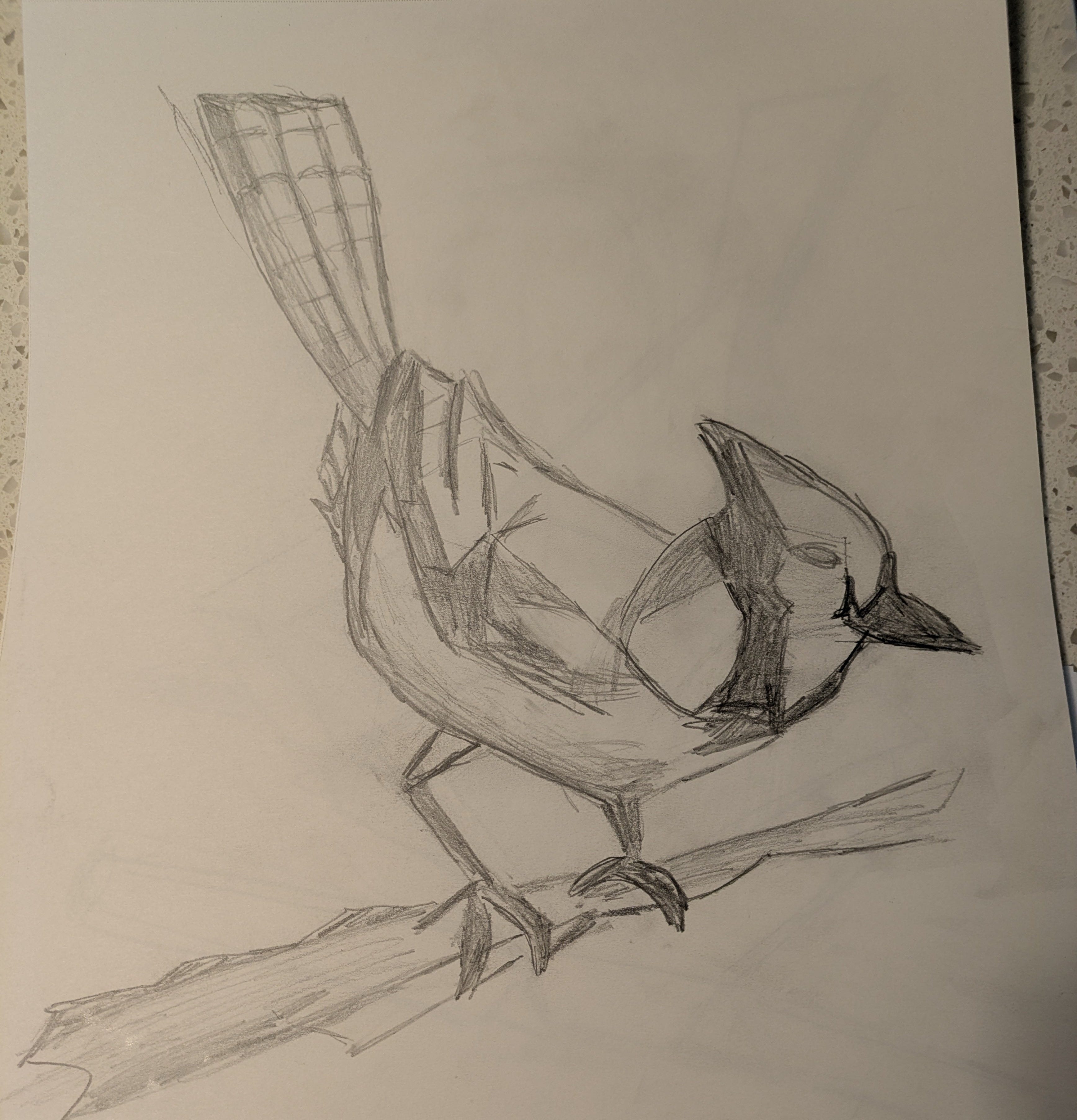
To my pleasant surprise, I found myself readily entering flow state with drawing, even though I am terrible at it. It requires patience and careful observation if one is to render something accurately on paper. Some of the classes I took let us draw freely — more gestural than precise. We tried capturing the essence of an object. Other classes, we focused on drawing portraits of live models. In one class, a live nude model posed in various ways and we attempted to capture his form on page.
Drawing a self portrait is the ultimate test of humility. You notice every blemish and stray line. My first two attempts look like caricatures. But I am not deterred. I found drawing portraits to be enjoyable. It is intimate and can be very sexy. Drawing an accurate portrait can be a wonderful compliment to someone. It is an opportunity to sit in stillness with them and show them that you truly see them.
Painting
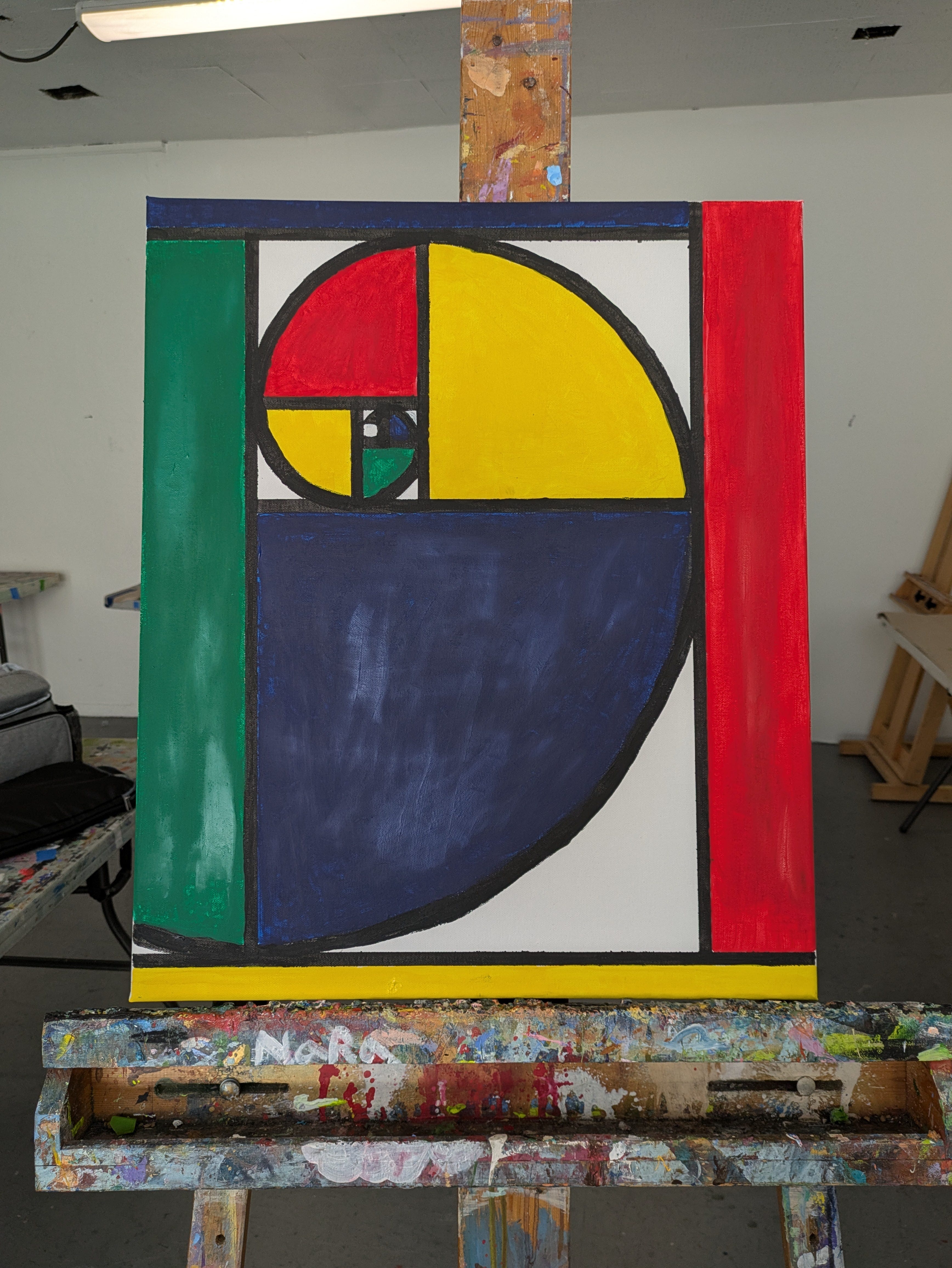
Unlike drawing, in my painting class, I found myself more interested in ideas than in representing reality. While the other beginners in the class focused on painting mugs, I wanted to paint something colorful and mathematical, with bold shapes. So I decided to mimic the style of Piet Mondrian and see if I could incorporate my own twist.
I made three practice paintings on acrylic paper before I moved on to painting on canvas. I decided to paint the golden spiral and rectangles in the style of Mondrian. It was challenging to develop a vision and strategy for measuring and drawing the spiral; using masking tape to ensure straight lines; composing the digital draft; and then attempting to paint with precision and evenness.
Here, too, I was happy with how the painting turned out. It is flawed, but it expressed a coherent idea from a clear vision. For a first attempt from a complete amateur, it passed my low bar. It did not quite take me into flow state like drawing, but it is something I will continue.
Conclusion
There is still so much to do and learn in the next ten months of the year. I am happy with my strong start and I am excited to see where it will go. I will continue the drawing, painting, comedy, and writing, but I also plan to return to spoken word, origami, photography, coding, and dance.
In a world saturated with technology, where much of our agency and choices are stripped from us, it is the ultimate flex to have a rich, inner world that is developed from an analog reality. Happiness comes from having as many instances of flow state as possible. It’s also never too late to begin learning a new skill. In ten years, who knows what I may be able to paint? Who knows if I will be acting in an improv troupe? The most important thing is to enjoy the process.