

It is generally accepted that the most complicated object in the known universe is the human brain. Remarkably, it is only about 1500 cubic centimeters (1.5 liters) and weighs about three pounds. The brain is composed of about 75 percent water. 60 percent of its dried weight is fat.
Scientists estimate that the brain has close to 85 billion neurons, with one quadrillion connections or synapses between them. For more palatable numbers, brain tissue the size of a grain of sand contains 100,000 neurons and one billion synapses.
At just two percent of the body’s weight, the brain consumes 20 percent of the body’s energy, primarily in the form of glucose. The brain generates about 25 watts of power (enough to power a dim LED light bulb). For context, power companies bill customers in kilowatt-hours (kWh), so we can use this calculation to determine the amount of energy consumed in 24 hours:
25 watts x 24 hours = 600 watt-hours or 0.6 kilowatt-hours
While the local electricity rates vary around the United States and the world, we can round the national average to 20 cents per kWh.
20 cents x 0.6 kWh = 12 cents
Therefore, the roughly 50,000 daily thoughts that drive our ability to read, dance, sing, paint, make love, operate machinery, calculate, reason, experiment, fight, or perform surgery are driven by a gelatinous, easily deformed structure about the third of the size of an American football and costs approximately 12 cents a day.
Of course, generating the electricity to perform the actions behind the thoughts are more expensive but not by much: water, oxygen, sleep, and a few well-balanced meals a day can be sufficient.
Meanwhile, a single metal and silicon-based H100 GPU by NVIDIA requires 700 watts. If we perform the same calculation as above, this works out to $2.85 per day. In other words, the GPU needs 28 times the energy at 23.75 times the cost.
Further, it has already been well documented how expensive it is to train AI models, to collect training data, and to establish the complex data infrastructure of massive cooling systems and high-voltage power. The brain self regulates at a steady 37 degrees Celsius.
Data centers may contain upwards of 100,000 GPUs. Even with all that processing power, we’re still waiting for robots to dance like us let alone correctly identify all the structures.
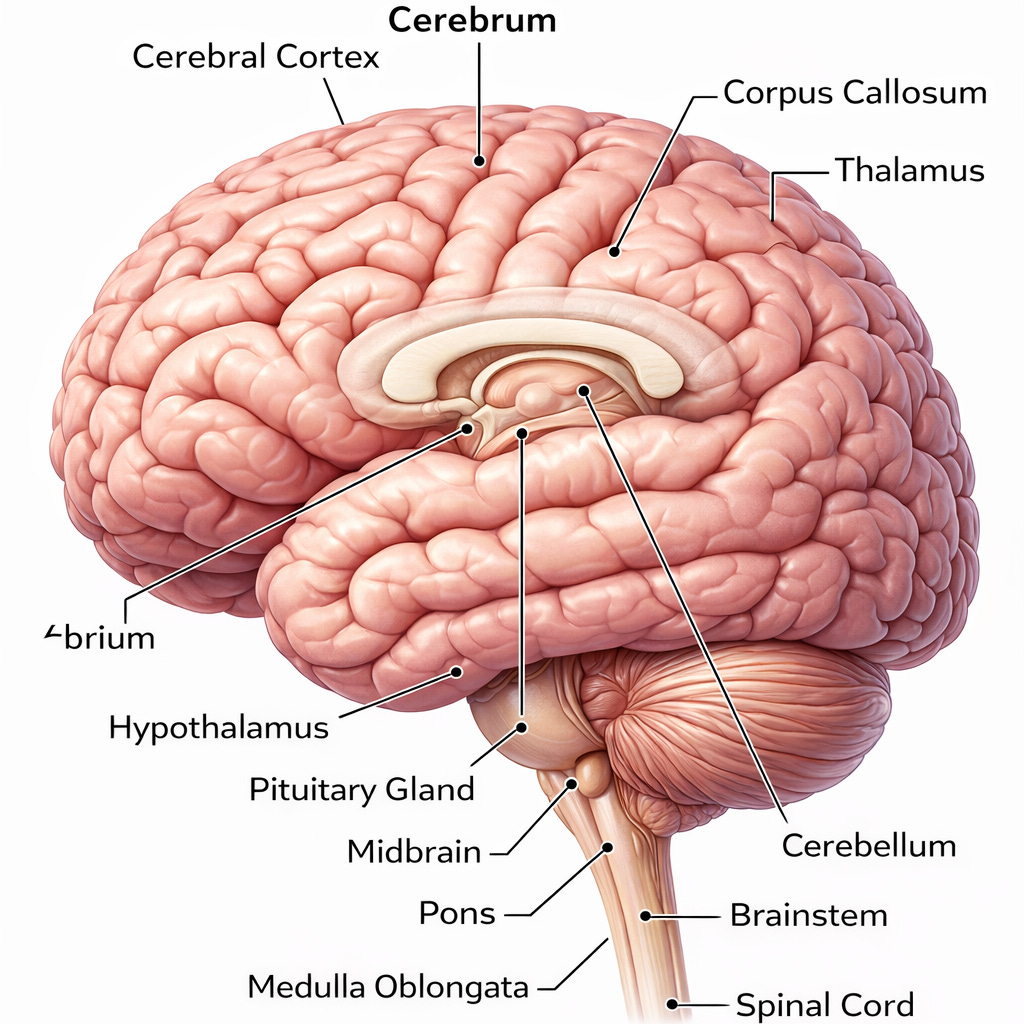
Therefore, the brain is not only the most complex entity in the universe, it is also the most energy-efficient processor in the known universe.
So what kind of audacity and hubris do humans possess that made us think we can achieve any sort of artificial general intelligence?

Of course, our brains are infamously fallible. Research has proven how we easily we forget events, how easy it is to implant memories in witnesses, how quick we lose track of time, how often we become overwhelmed when multitasking or stressed or hungry or fatigued.
Yet, our brains are incredible problem solvers. If we come across a new type of door handle or even a website, it does not take long for us to figure out how it works. A couple of rounds of trial and error and we are soon up and running. Maybe we solve it on our first try. Meanwhile, a robot or agentic AI may never figure out how to open the door or order the pizza. It will also sooner hallucinate.
When the AI and LLM hype is at its peak, when the AI CEOs and analysts and gurus are breathlessly espousing that the transformation of humanity is just around the corner, it sounds to me like the claims of every religious and cult leader since the dawn of time.
“The future is coming! The fall of mankind is at hand. But we possess a power that can provide salvation. It can cause great harm but also tremendous opportunity. You must trust us to harness and wield its strength. Our technological elixir can do everything you can but exponentially better. You can even have sex with it! We alone can save you! Also, you’re not going to have a job in ten years, but you can worry about that later!”
Anytime in human history where we have purported to possess awe-inspiring, God-like powers, these claims are eventually debunked. Every. Single. Time.
Yes, we possess incredibly powerful weapons of annihilation, but destroying something is easy. Building something is hard. An AI robot can shoot you, but can it repair the damage?
Once again, who do humans think we are to consider a possibility that we are a few short years from replicating anything close to the human brain? Can you name another organ that we have effectively replaced that does not come from another human?
At best, the medical technology that we do possess does an inefficient job assisting in the body’s functions. A ventilator might help a patient breathe, a cochlear implant may help a patient hear, and dialysis will do the work for a patient’s kidneys. Even the left ventricular assist device (LVAD) will augment the work of a patient’s heart. But these are devices and technologies with complications and side effects and limitations.
Even implanted brain-computer interface implants, as important as they might be for those contending with the limitations of paralysis or paraplegia, will not enhance the brain to better than it was before. At least not anytime soon. But it will not revive or replace a non-functioning brain.
Of course I may have to eat my words one day. But chances are that I will be long dead before I have to do so. In the meantime, it is best if we proceed with caution and humility. AI has the awesome ability to destroy so we must respect its power. But the invention of fallible AI technology required the collective processing power of the most complex and efficient processor in the known universe over generations. We don’t even know how the brain fully works, let alone a large language model.
Once again, it bears repeating: who do we think we are?