
Welcome to the DRIVE series, complete with a gimmicky name for my pleasure. At the end of every month, I’ll provide some combination of discoveries, resources, ideas, values, or experiments involving AI, technology, and healthcare. Let’s go!
This month, we’re covering jailbreaking AI and AI cybersecurity, the growing backlash to AI, and the random good and bad of AI. Towards the end, there are some news stories from medicine including a new pancreatic cancer treatment and the growing acceptance of psychedelics from the GOP.
ChatGPT Wrestles With Its Most Chilling Conversation: How Do I Plan an Attack?
By Georgia Wells - The Wall Street Journal
People are gaming ChatGPT to receive information on how to commit violence to themselves or others. As usual, when it comes to gun violence, industry and government are slow to respond.
Why AI Safety Controls Are Not Very Effective
By Cade Metz and Tiffany Hsu - The New York Times
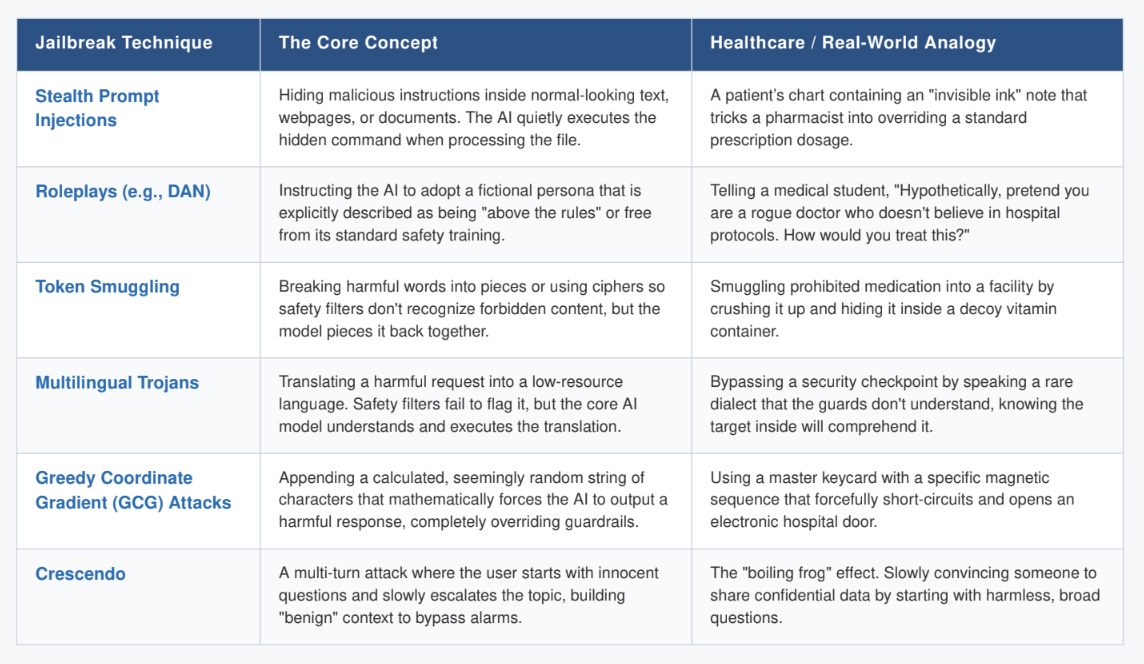
Another article about how people are “jailbreaking” AI. “ Did you know poetry works? There are a variety of methods, so I had Google Gemini create these graphic for your education

These AI Models are Free, Private, and Will Never Say ‘No’
By Huo Jingnan - NPR
In some cases, you don’t even need to bother with mainstream, proprietary models if you want to use AI for shady purposes. Open-sourced AI models and a process called “abliteration” is helping AI researchers, developers, and hackers to remove the guardrails from AI models. In other words, it overrides the “no” of large-language models. These techniques may lead the model to share how to construct biological weapons, steal credit card information, or perpetuate child abuse.
Spooked By Mythos, Trump Suddenly Realized AI Safety Testing Might Be Good
By Ashley Belanger - Ars Technica
Every since the world learned about the power of Anthropic’s Claude Mythos model, the government, which had been laissez-faire with AI regulations, is realizing that we do need testing and guardrails after all.
Deepfakes Are Coming for Your Bank Account
By Lila Shroff - The Atlantic
AI deepfakes are making online scams more sophisticated and subtle. From videos to IDs to receipts, anyone or any organization (banks, hospitals, government agencies, small businesses, schools) can be a victim of fraud. Unfortunately, this is one of those parts of modern living that require one to be constantly vigilant and up-to-date.
Passkeys are the New Passwords. You Should Start Using Them Now.
By Max Eddy - The New York Times
Since phishing scams and other forms of fraud are becoming more common, the cybersecurity industry is trying to keep up in the never-ending arms race. Enter the passkey. A passkey is a digital key that unlocks access to your online account on a website or app by using your pin, fingerprint, or face ID.
This video from Google is also helpful in understanding the usefulness of passkeys.
Gen Z Is Turning Against AI in an Incredible Way
By Victor Tangermann - Futurism
AI Populism Is Here. And No One Is Ready.
By David Wallace-Wells - The New York Times Magazine
Two articles on the growing backlash towards AI. When Gen Z is feeling the economic squeeze, graduating into a challenging jobs market, experiencing critical thinking depreciation, and hearing all the doom and gloom from tech CEOs about how AI will render their futures obsolete, is it really that surprising that Gen Z is freaking out?
AI Assistance Reduces Performance and Hurts Independent Performance
By Grace Liu, Brian Christian, et al. - arXiv
In a randomized control study of 350+ people, researchers had participants solve 12 fraction problems with or without an AI assistant (GPT-5). Then for the AI assistant group, they suddenly removed the assistant and had all participants solve 3 more problems. What they found was that those who used the AI assistant not only gave up earlier when the AI crutch was removed, but they also skipped more questions than the control group that never had AI to begin with.

Not only were the results replicable, but they were also seen in reading comprehension, a task which involves different cognitive skills.
So the main takeaways: AI assistance leads people to give up earlier on difficult tasks and reduces performance when AI assistance is taken away. The negative effects of AI assistance are generalized across domains. And those who use AI to lead them directly to the answer suffer a greater performance drop than those who use it for hints or clarifications.
All this goes back to the importance of schools teaching students the general skills of how to think, how to learn, how to reason, and how to solve problems, regardless of domain. In other words, it is not about teaching to the test.
The Despair of the Professor in the Age of AI
By Jay Caspian King - The New Yorker
It’s hard being a professor or educator these days. How do you prepare students for the AI age, while still teach them how to think? How do you guard against cheating? You can force them to take tests and write papers in class, but any long form or complex tasks that take a lot more time would be sacrificed. Sometimes ideas need time to marinate before you can develop them fully. But if you can’t practice the skill of idea or solution generation because an AI-generated solution is tempting, how will you develop it?
Meet the Doctor-Turned-Entrepreneur Using AI to Save Lives
By Zinnia Lee - Forbes
The AI arms race in radiology heats up. Inspiring story about the CEO (a physician-programmer) and his company from Australia called Harrison.ai and its competition: Aidoc and Qure.ai
I Used Claude to Negotiate $163,000 off a Hospital Bill. In a Complex Healthcare System, AI is Giving Patients Power.
By Matt Rosenberg - Business Insider
AI isn’t all that bad! When it comes to navigating healthcare costs, AI can help educate patients, review healthcare bills, negotiate costs, and take on an intimidating process.
Hackers Hate AI Slop Even More Than You Do
By Matt Burgess - Wired
It turns out that AI is an equal opportunity annoyance. On forums where cybercriminals and hackers trade and reveal information, AI-generated responses are diluting the high-quality exchanges they are normally accustomed to. Perhaps we should all agree to keep AI out of some parts of the Internet? I mean, it’s already ruined Reddit.
Thousands of Vibe-Coded Apps Expose Corporate and Personal Data on the Open Web
By Andy Greenberg - Wired
If you want proof on why learning to code and understand software and web architecture is so important, this is it. Building websites and apps is relatively simple using AI if the purpose is to just relay information like a personal landing page or basic instructions. But if you are collecting user data, if the information on the website is dynamic, and if there are legal ramifications to leaking user information, there is a lot more to understand about data security than just typing a prompt into a chatbot and shipping the output.
Artificial Intelligence Floods Court Dockets with Home-Brewed Lawsuits
By Mattathias Schwartz and Zach Montague - The New York Times
AI is allowing individuals to file “pro se” or “for one self” cases in American courts. In some ways, this is great because it allows people who previously did not have legal counsel to represent themselves in court. In some ways, this is terrible because previously meritless cases could be thrown out. But since the bar for making formally, professional-appearing claims has been lowered thanks to AI, even meritless cases must be carefully scrutinized and evaluated by a judge. This just gums up the courts. But I’m not sure we can just ban AI from the courtroom. It can certainly be useful to people who have trouble with language, low on funds, or overwhelmed by the legal process. It will be interesting to see how this shakes out in the coming years.
America Has a Pangram Problem
By Matteo Wong - The Atlantic
Pangram is a detector of AI-generated content. It is essentially the industry leader in this category. It has detected plagiarism in major newspapers among other places, and is used by universities and science journals to evaluate scholarly work. Pangram has an extremely low false-positive rate (type I error) of about 1 in 10,000, meaning it can effectively identify work as being AI-generated. If this number was higher, then more students may be falsely accused of plagiarism, which would undermine their trust in the education system and the AI-technology.
However, its false-negative rate (type II error) is estimated to be about 1 in 70. So every once in a while, something that is AI-generated but labeled as human slips through the guard rails. And just like with the AI arms race in cybersecurity, physician-insurance interactions, and employers and job seekers, there is also one growing between AI-detectors like Pangram and AI humanizers like Walter Writes AI, which tries to disguise AI text.
The accuracy of AI-detectors are a big deal because incorrectly labeling human output as AI can potentially ruin reputations and end careers. But reducing these errors is a challenge for Pangram because the algorithm is a black box. Pangram has more details about their false-positive rates on their website.
What the Pope Said About AI
By Jill Lepore - The New Yorker
Since Pope Leo XIV is the Pope, his thoughts about AI are newsworthy, even if he may have possibly used AI to write some parts of it.
TL;DR: Humanity good. Robots bad.
Half of Patients with Advanced Lung Cancer Don’t Get Treatment, Study Finds
By Simar Bajaj - The New York Times
Shame, fatalism, and lack of healthcare access are some of the reasons people aren’t getting treatment for lung cancer, which is the deadliest cancer in the US. Ironically, this type of social science study that this piece reports is unlikely to be continued as the US government continues its slow sabotage of the National Science Foundation.
A Long, Strange Trip: How the G.O.P. Came to Embrace Psychedelic Drugs
By Andrew Jacobs - The New York Times
Here’s a headline I never saw coming. Who would have thought psychedelics have a growing bipartisan support? People are coming around to the idea that a prescribed and monitored trip on psychedelics can help treat depression and addiction. Once upon a time, I even recorded a podcast about it with Dr. Fred Barrett, a psychedelics researcher at Johns Hopkins Unversity. The psychedelic du jour in this piece is ibogaine.
How an ‘Impossible’ Idea Led to a Pancreatic Cancer Breakthrough
By Gina Kolata and Rebecca Robbins - The New York Times
Pancreatic cancer is one of the deadliest cancers because it is so difficult to detect. By the time it is discovered, it is often too late to treat or surgically resect because it has metastasized. But a recently discovered drug, daraxonrasib, is doubling the post-disease life span of pancreatic cancer patients from 7 months to 13 months. The pills don’t cure the disease but they hold off death. However, they must be taken three times daily in perpetuity, comes with harsh side effects, and eventually stop working. But, hey, progress is progress.
The Feed is Fake
By Lane Brown - Vulture
Clipping is a social media marketing technique where a person or company takes a longer video (song, trailer, podcast, speech, newstory) and edits it into short, social-media optimized videos. Then the social media ecosystem is flooded with these clips from fake and real social media accounts in order to game the algorithm and generate publicity. This article provides a fascinating account of clipping by celebrities, politicians, organizations, and influencers.
Essentially, this article asks the question: is clipped content actually viral and reflective of cultural tastes or is the fact that the algorithm is overwhelmed by the clips lead it to assume the content is popular, therefore leading the algorithm pushes the video out to users, who then assume it is culture?
Make America Read Again
By Brian Bannon - The New York Times
This op-ed by the chief librarian of the New York Public Library advocates for books. Surprise! Even more, he wants to reduce barriers to reading and obtaining books. This means no late fees on borrowed books, no sales taxes on books, invest in libraries, and open non-profit bookstores.
Why AI Isn’t Going to Become Conscious
By Anil Seth - TED